
Real estate legal and tax management course adapted to the housing act

Course description
The real estate legal and tax management course adapted to the Housing Act (Ley de Vivienda, Spain's housing law) offers comprehensive training for real estate professionals who want to expand their knowledge of legal and tax matters. The programme is designed to explore in depth the current legal framework and the tax obligations that affect property transactions, ensuring that property intermediaries and advisers are properly prepared.
In this online course you will learn to manage the property rights, planning and land registry matters associated with ownership, and to master the tax aspects that affect the sector, from local to national taxes. You will also become familiar with contractual documentation and current regulations, including adaptation to the new Housing Act — essential for operating safely and reliably.
The course is aimed at property intermediaries, agents and advisers who want to become more competitive by strengthening their real estate and legal knowledge. The online format gives you the flexibility to study from anywhere at your own pace, making it easy to balance with other commitments.
This programme is competitively priced at 395 euros and gives you the option of taking additional optional modules to broaden your knowledge of client acquisition, sustainable real estate and residential market trends. All-round training to boost your professional performance in an ever-evolving sector.
What you will learn
This course provides the skills needed to carry out professional duties in the legal and tax side of real estate related to housing management and property intermediation. The specific objectives students will achieve are:
- Manage property rights relating to ownership, such as rights of use and security interests.
- Apply current planning regulations, including urban planning and planning certificates.
- Correctly interpret and use the Land Registry (Registro de la Propiedad) and its entries.
- Consult and analyse cadastral information and its main references.
- Carry out complete property purchase and sale processes and manage lettings.
- Correctly draw up and assess real estate documentation and contracts.
- Classify and manage the local, regional and national taxes that apply to the real estate sector.
- Adapt tax knowledge to current legislation according to the client's place of residence.
Syllabus
MODULE 1: Real estate law
Study and application of the property rights affecting real estate, including the rights of use and security interests that are essential to property management.
1.1 Property rights (rights of use, security interests...)
Understand the types of property rights that can apply to a property and their implications for transactions.
1.2 Urban planning (planning, certificates...)
Analysis of planning regulations, land-use planning and the certificates that affect the use and development of land.
1.3 Land Registry (registers and entries, marginal notes, cautionary notices...)
How the Land Registry works, and how to interpret its registers, entries and types of notice to ensure legal certainty.
1.4 Cadastre (information, searches, reference index...)
Consulting and using cadastral information for valuing and managing properties.
1.5 Buying and selling step by step
The complete purchase and sale procedure, from negotiation to legal completion and registration.
1.6 Lettings
Regulations and management of tenancy agreements, and key aspects for administering them correctly.
1.7 Documentation and contracts
Drafting and analysing the legal documentation required in property transactions.
MODULE 2: Real estate taxation
Classification and application of the local, regional and national taxes that affect the real estate sector.
2.1 Classification of taxes – fees, taxes and special contributions
Distinguishing between the types of tax and their impact on property transactions.
2.2 Local taxes relating to the real estate sector
A study of the municipal taxes and fees that affect the sector.
2.2.1 IIVTNU (Plusvalía Municipal)
The tax on the increase in value of urban land.
2.2.2 ICIO
The tax on construction, installations and works.
2.2.3 IBI
The property tax (Impuesto sobre Bienes Inmuebles) and how it applies in practice.
2.3 Regional taxes (overview adapted to the participant's place of residence)
An overview of regional taxes and how the rules vary depending on the autonomous community of residence.
2.3.1 ITPAJD
Property transfer tax and stamp duty on documented legal acts.
2.3.2 ISD
Inheritance and gift tax in property transactions.
2.4 National taxes
A complete overview of the national taxes that affect the sector.
2.4.1 IVA
Value Added Tax (VAT) applicable to taxable property transactions.
2.4.2 IRPF (capital gains, income from real estate, imputed income...)
Tax treatment of income and gains from property for individuals under Spanish personal income tax.
COMPLEMENTARY MODULES (optional)
MC.1 Listings & S.U.E.R.T.E.
Strategies for making effective use of the resources available to succeed in winning property listings.
MC.2 Committed and sustainable real estate
Principles and practices that make a difference when operating with environmental and social criteria in real estate.
MC.3 New trends in the residential market
Exploring innovative formats such as co-living, cohousing and build-to-rent, and their impact on the residential sector.
Career opportunities
After completing the course, students will be qualified to work in a range of roles in the real estate sector focused on legal and tax management. This training opens doors to jobs that require up-to-date technical specialisation in line with the new regulations.
- Real estate legal manager
- Tax adviser for property transactions
- Property intermediary specialising in legal and tax regulations
- Real estate consultant for sales and lettings
- Staff member in asset management departments
Sectors and companies:
- Estate agencies
- Asset management and real estate companies
- Legal and tax departments of real estate organisations
- Consultancies specialising in the real estate sector
Other Real Estate courses
🏠 Expand your training with more courses in this area
 Real Estate
Municipal capital gains tax (plusvalía municipal): how to calculate the IIVTNU
A 3-hour videoconference course on calculating the IIVTNU, Spain's municipal tax on the increase in value of urban land, updated in line with Royal Decree-Law 26/2021.
 Real Estate✓ Accredited
Accredited real estate agent course (AICAT)
Accredited online training to obtain the official AICAT real estate agent qualification. No prior requirements, 210 hours, with a strong practical and legal focus.
 Real Estate
Protected housing in Catalonia: from the law to practice
In-person and videoconference training on protected (subsidised) housing in Catalonia, with downloadable materials and limited places. Competitively priced, with a practical focus.
 Real Estate
Land valuation, construction costs and investment feasibility
Professional training in land valuation and feasibility analysis for property developments, at a competitive price and with practical content for the real estate sector.
 Real Estate
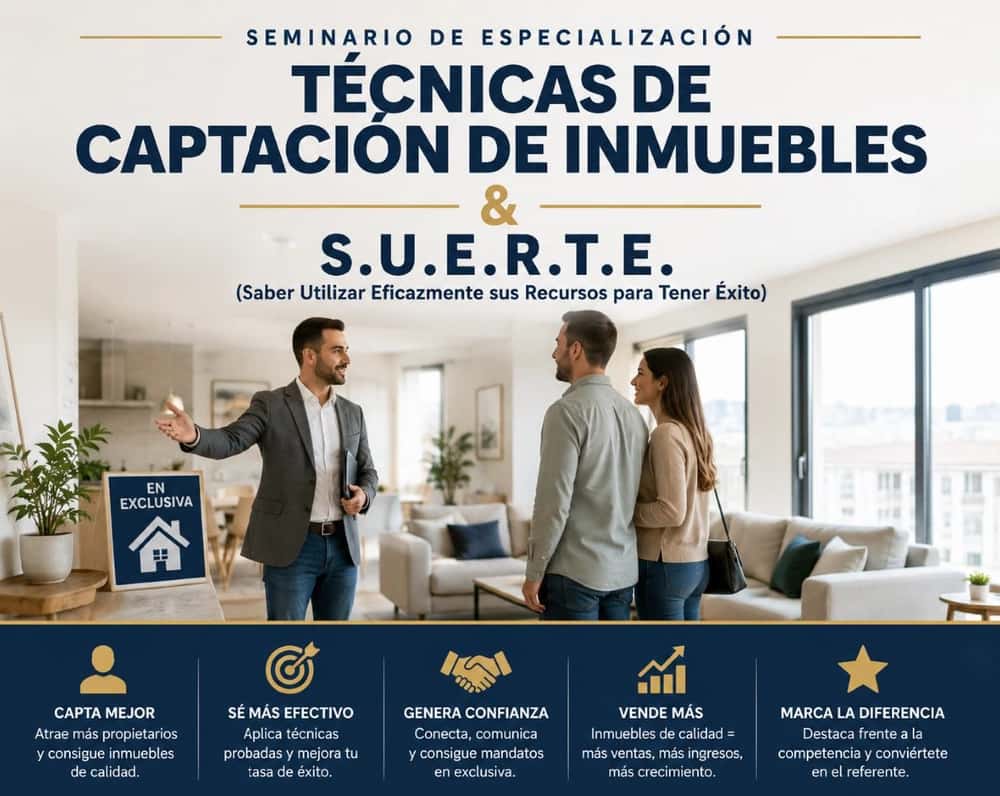
Property listing acquisition techniques course
Learn to win property listings effectively with a proven methodology and advanced techniques. Includes downloadable materials; places on this specialist course are limited.
 Real Estate
Real estate personal shopper and property manager course, adapted to Spain's regions
50-hour online course to become a real estate personal shopper, with practical content adapted to the new Law 12/2023 and an up-to-date professional approach.